
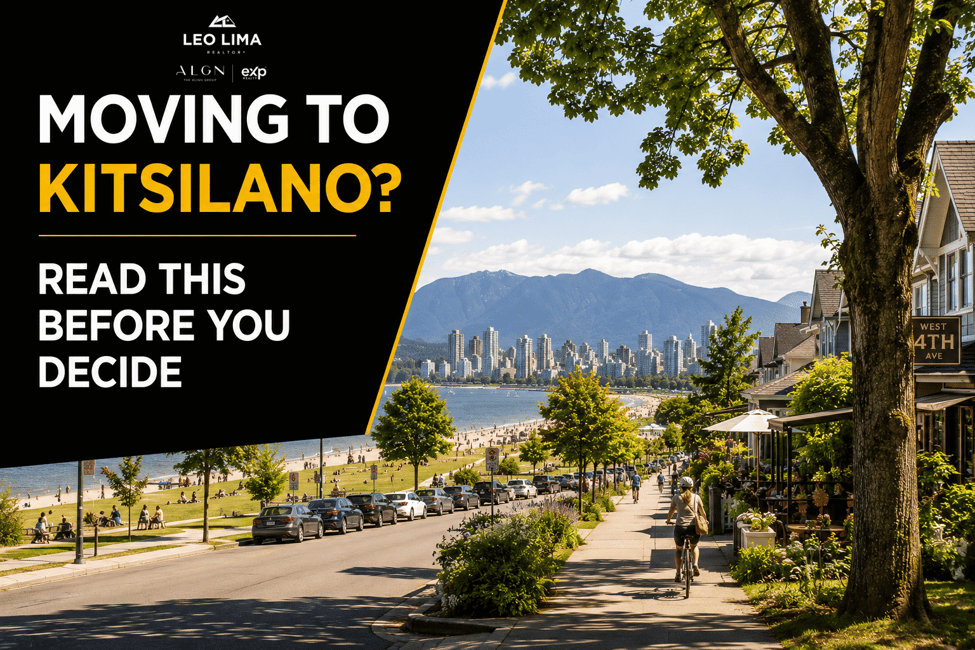
Moving to Kitsilano? Read This Before You Decide
June 4, 2026
By: Leo Lima
Kitsilano gets talked about a lot. It shows up on every "best neighbourhoods in Vancouver" list, and buyers from across the city and from outside Canada ask me about it constantly. But the version most people have heard is the polished one. This article is the fuller picture — what the neighbourhood actually delivers, where it genuinely falls short, and who it makes the most sense for.
Question: Is Kitsilano the right neighbourhood for you?
Short Answer: For a lot of people, yes. Kitsilano has a lifestyle that is genuinely hard to replicate anywhere else in Vancouver. But it comes at a price, it has real limitations, and it's not for everyone. The buyers who end up happiest here are the ones who went in with accurate expectations, not inflated ones.
This article covers:
- What Kitsilano actually looks like day to day
- The real cost of living here in 2026
- What it's good for, and where it falls short
- Transit, parking, and getting around
- Who Kitsilano is best suited for
What Kitsilano Actually Looks Like Day to Day
Q: What is the day-to-day experience of living in Kitsilano?
A: Kitsilano is a low-rise, walkable neighbourhood on the west side of Vancouver, bounded roughly by Burrard to the east, Alma to the west, 16th Avenue to the south, and English Bay to the north. The beach runs along the northern edge. Kits Pool, one of the longest outdoor saltwater pools in North America, sits right on the water.
The main commercial streets are 4th Avenue and Broadway. Fourth Avenue is the more neighbourhood-focused of the two, with independent coffee shops, restaurants, yoga studios, and local retail. Broadway is busier, more transit-oriented, and home to a mix of grocery stores, pharmacies, and services.
Most of the residential streets are quiet, lined with character homes, mature trees, and a mix of older condos and newer strata buildings. The blocks south of 4th have a different feel from the blocks near the beach. Closer to the water, density is lower and prices are higher. The further south you go, the more the character shifts toward the Fairview and Mount Pleasant boundaries.
Day to day, Kitsilano has a rhythm that a lot of people find hard to give up once they've had it. Walk to the beach in the morning, coffee on 4th, everything you need within 10 to 15 minutes on foot. That's the lifestyle that drives demand here and keeps it high.
The Real Cost of Living in Kitsilano in 2026
Q: How much does it actually cost to buy or rent in Kitsilano right now?
A: Kitsilano is one of the most expensive neighbourhoods in an already expensive city. Here's where the market sits as of May 2026.
For attached properties, there are 129 active listings with a 27% sales ratio. Average days on market is 16, and homes are selling at 97% of list price. Entry-level condos in the area generally start above $700,000. A 2-bedroom near the beach or south of 4th will typically run $1.1 million and up.
For detached homes, 50 active listings with an 18% sales ratio and homes selling at 94% of list in about 19 days. A detached house in Kitsilano starts around $2.5 million in most of the neighbourhood, with properties near the water or on premium blocks pushing well above $3 million.
Rentals reflect the same pressure. A 1-bedroom in Kitsilano runs roughly $2,500 to $3,000 per month. A 2-bedroom is typically $3,500 and up.
The cost of entry is real. Most buyers who move here are dual-income households, equity-rich homeowners rolling proceeds from another property, or investors. First-time buyers with a single income face a genuine challenge in this market.
What Kitsilano Is Good For
Q: What does Kitsilano do better than most Vancouver neighbourhoods?
A: A few things stand out.
The beach and outdoor access are unmatched at this price point. Kits Beach, Jericho, and the Point Grey foreshore are all within reach on foot or by bike. For anyone who wants to be near the water without living in West Vancouver or Point Grey, Kitsilano is the answer.
The restaurant and coffee scene on 4th Avenue is strong and genuinely local. You won't find a lot of chains here. The independent operators on 4th have anchored the street for years.
The community feel is real. Kitsilano has a resident base that actually uses the neighbourhood. Farmers markets, local events, and a pedestrian culture that feels different from the more transient parts of the city.
Families with young children do well here. The parks are good, the streets are safe, and the school options within and near the neighbourhood are solid.
Where Kitsilano Falls Short
Q: What are the honest limitations of living in Kitsilano?
A: Transit is the most common frustration. The Broadway SkyTrain extension is underway and will eventually improve east-west connectivity, but as of 2026 Kitsilano is not a subway neighbourhood. The 9 and 14 bus routes run along Broadway and 41st, but if you work downtown and don't want to drive or cycle, you're looking at 30 to 45 minutes each way on a good day.
Parking is tight, especially near the beach and on 4th Avenue. Street parking has time limits during the day, and residential permits don't solve the problem entirely. If you have two cars, you will feel this.
Groceries and errands require some planning. There's no large supermarket right on 4th. The Safeway on Broadway covers most needs, but it's a walk or a short drive for anything beyond basics.
The price floor is a genuine barrier. There is no budget tier in Kitsilano. If you're priced out, you're priced out, and the neighbouring options in the same school catchments carry similar premiums.
Transit, Parking, and Getting Around
Q: Is Kitsilano practical if you don't own a car?
A: Manageable, but not effortless. The Broadway corridor is well-served by bus. Cycling infrastructure has improved significantly, with protected lanes on several routes connecting Kitsilano to downtown and the rest of the west side. If you work near Broadway, Granville, or downtown and are comfortable cycling or taking the bus, you can get by without a car.
If you regularly travel south of 16th, commute to Burnaby or Surrey, or need to do a large grocery run regularly, a car makes life considerably easier. Most households in Kitsilano have at least one vehicle.
Who Kitsilano Is Best Suited For
Q: What type of buyer or renter is actually the best fit for Kitsilano?
A: Kitsilano works best for people who genuinely value walkability, outdoor access, and a neighbourhood identity over square footage and car dependency. The ones who thrive here are usually couples or young families who use the neighbourhood actively, professionals who want a short commute to downtown or the Broadway corridor, and people who've lived in Kitsilano before and already know they want to come back.
It's a harder fit for buyers who need a lot of space for the price, who work primarily in the suburbs, or who are primarily looking for value per square foot. There are better options for that in East Vancouver, Burnaby, or further south on the west side.
If you're seriously considering Kitsilano and want a straight read on whether it fits your situation and budget, I'm available 9am to 9pm, 7 days a week. Call or text 604-813-5398 or visit vandreamhomes.ca.
Disclaimer: This article is for informational purposes only and does not constitute legal or financial advice. Market data referenced is sourced from SnapStats Vancouver Westside May 2026 and REBGV April 2026. Market conditions change. Consult a licensed real estate professional before making any real estate decisions.
About Leo Lima
Leo Lima is a Realtor with eXp Realty and The Align Group, specializing in Kitsilano and the Vancouver West Side. Originally from Brazil, Leo has been a Vancouver resident since 2017 and a Canadian citizen. He works with buyers, sellers, and investors across the Greater Vancouver Area and serves clients in English, Portuguese, and Spanish.
Leo Lima - Realtor / Kitsilano Real Estate Expert / 604-813-5398 / vandreamhomes.ca