
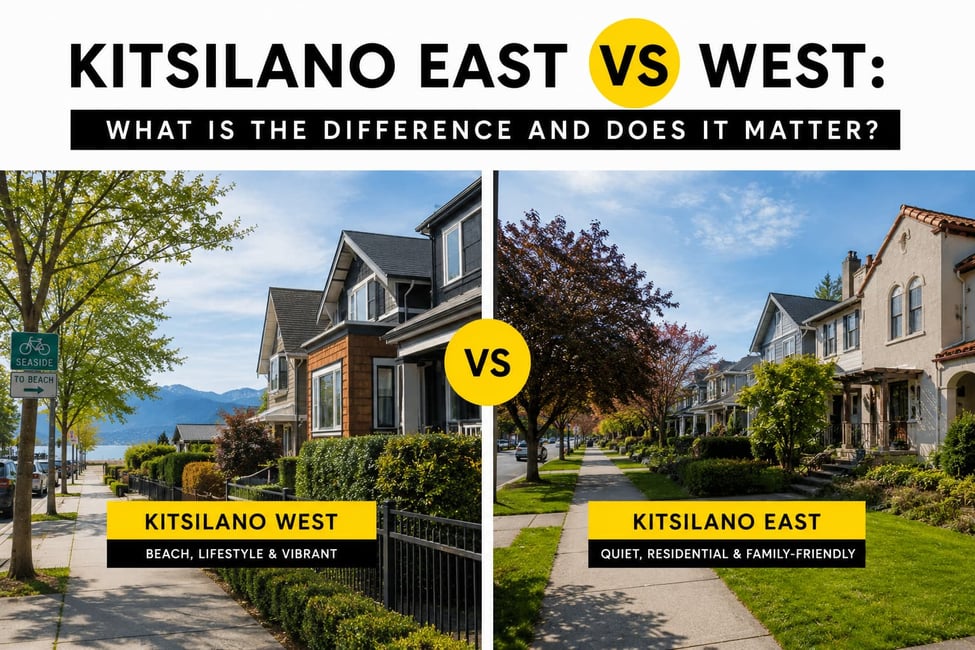
Kitsilano East vs West: What Is the Difference and Does It Matter?
May 6, 2026
By: Leo Lima
If you've spent any time looking at listings in Kitsilano, you've probably noticed that two properties with similar square footage, similar age, and similar finishes can carry price tags that are $200,000 to $400,000 apart. Sometimes more. That gap almost always comes down to one thing: which side of Macdonald Street the property sits on. Most buyers don't know this until they're deep into their search. Here's what actually separates east Kitsilano from west Kitsilano, and why it matters for your decision in 2026.
Question: What is the difference between Kitsilano East and West, and does it actually matter for buyers?
Short Answer: Yes, it matters significantly. West Kitsilano, loosely defined as the area west of Macdonald Street toward Alma Street, carries a meaningful premium over east Kitsilano near Burrard Street. The gap reflects differences in lot size, school catchment quality, traffic exposure, distance to the beach, and the broader character of the streets themselves. For detached buyers especially, crossing to the wrong side of Macdonald Street can mean buying into a structurally lower-value micro-market at a price that doesn't reflect that reality.
What this article covers:
- How Kitsilano is geographically divided and what that means in practice
- The price gap between east and west Kitsilano and what drives it
- School catchment differences across the east and west divide
- How the condo market differs between east and west Kitsilano
- Which side suits buyers at different budget levels
- The one area where east Kitsilano is actually the smarter buy right now
- A clear closing advisory for buyers choosing between the two
- Internal links to current listings at vandreamhomes.ca
How Is Kitsilano Actually Divided?
Q: Where exactly does east Kitsilano end and west Kitsilano begin?
A: Kitsilano runs from Burrard Street on the east to Alma Street on the west, and from the waterfront down to West 16th Avenue on the south. The neighbourhood is officially one MLS zone with one benchmark price. But in practice, Macdonald Street acts as the most meaningful dividing line within the neighbourhood.
East Kitsilano refers loosely to the area between Burrard Street and Macdonald Street. This is where you find more of the older wood-frame condos, smaller lot detached homes, and properties with more traffic exposure from Burrard Bridge approach corridors and the commercial density of lower Broadway. It's also where the most affordable Kitsilano real estate sits.
West Kitsilano refers to the area between Macdonald Street and Alma Street. This is quieter, more residential, and home to most of the neighbourhood's premium detached housing stock. Lots tend to be larger. Streets like Balaclava, Waterloo, Collingwood, and Trafalgar carry the heritage character and tree canopy that define what most people picture when they think of Kitsilano at its best. The beach is also closer for properties on the western and northern sections of this area.
It's worth noting that Arbutus Street within the neighbourhood also functions as a secondary dividing line for condo buyers, particularly given the Broadway Subway Arbutus Station's influence on values along that corridor.
How Big Is the Price Gap and What Drives It?
Q: How much more does west Kitsilano actually cost compared to east Kitsilano?
A: For detached homes, the gap is significant and has been consistent across market cycles. Properties on the premium streets west of Macdonald, streets like Balaclava, Waterloo, and Collingwood, typically trade at a premium of $200,000 to $400,000 above comparable homes on the eastern side of the neighbourhood near Burrard. On a $2.4 million purchase, that's a 10% to 17% premium for the same neighbourhood badge.
The April 2026 REBGV data shows the Kitsilano detached benchmark at the Vancouver West level, where the overall benchmark sits at $2,979,500, down 11.6% year-over-year. Within Kitsilano specifically, the SnapStats April 2026 data shows 48 active detached listings and only 4 sales, an 8% sales ratio. Homes are selling on average 7% below list price. But that average masks a meaningful spread. The homes transacting closest to their asking price in Kitsilano detached are almost exclusively on the premium west-of-Macdonald streets. The homes sitting longest and receiving the deepest discounts are predominantly on the eastern and southern sections of the neighbourhood.
Four factors explain most of the gap. Lot size is the first and biggest: west Kitsilano has more 50-foot lots, which carry development optionality and land value that 33-foot lots near Burrard don't support to the same degree. Traffic exposure is the second: properties near the Burrard Bridge approach and along Broadway face meaningfully more noise and congestion than the quiet residential blocks west of Macdonald. Beach proximity is the third: the waterfront and the seawall are genuinely more accessible from the western section of the neighbourhood, and that lifestyle proximity is priced. School catchments are the fourth, covered in detail below.
How Do School Catchments Differ Across the East and West Divide?
Q: Do school catchments actually change between east and west Kitsilano?
A: Yes, and this is one of the most searched questions among family buyers in this neighbourhood. The catchment boundary for Kitsilano Secondary's French Immersion program runs through the neighbourhood, and the elementary school catchments shift depending on your exact address. For families with children, this is not a detail. It's a core part of the buying decision.
Henry Hudson Elementary on Yew Street near Cornwall Avenue serves the northern and western sections of Kitsilano. Bayview Elementary on West 2nd Avenue serves properties in the mid-western section. Lord Tennyson Elementary on West 10th Avenue serves the southern portion of west Kitsilano, while General Gordon Elementary on West 10th Avenue near Maple Street covers properties in the eastern zone of the neighbourhood.
All four are well-regarded public elementary schools, but the catchments for Henry Hudson and Bayview in the northern and western sections carry the most consistent buyer demand from families specifically motivated by school proximity. At the secondary level, Kitsilano Secondary is the public high school for the neighbourhood, offering both French Immersion and Advanced Placement programs. Properties closest to the school, in the western and central sections of Kitsilano, tend to see the most consistent family buyer demand.
St. John's School on West 16th Avenue, an International Baccalaureate private school, draws additional demand to properties in the southern sections of west Kitsilano regardless of the public catchment map. Families who intend to use private secondary education find proximity to St. John's a meaningful factor in their street selection.
How Does the Condo Market Differ Between East and West Kitsilano?
Q: Does the east versus west divide matter as much for condo buyers as it does for detached buyers?
A: Less so, but it still matters. The April 2026 SnapStats data shows Kitsilano attached at 117 active listings and 29 sales, a 25% sales ratio with an average sale price of $925,000. The Vancouver West condo benchmark from the REBGV April 2026 report sits at $790,300, down 6.8% year-over-year. Metro Vancouver overall condo benchmark sits at $703,000, down 7.9%.
For condo buyers, the east-west distinction plays out primarily in building type and corridor positioning rather than street-by-street premiums. The eastern section of Kitsilano near Burrard has a higher concentration of older wood-frame walk-up buildings from the 1960s and 1970s. These buildings trade at a lower price per square foot than the concrete mid-rises in the central and western sections of the neighbourhood, and they carry higher long-term maintenance risk. Studios and one-bedrooms in these buildings can be found starting around $490,000 to $580,000, which represents the most affordable Kitsilano condo entry point.
The central and western condo corridors, particularly along Yew Street, Vine Street, and the Arbutus area, carry concrete mid-rise and newer boutique building product that benchmarks meaningfully higher per square foot. These buildings attract stronger owner-occupier demand, tighter resale competition, and more defensible long-term values.
The Arbutus corridor is the one area where the east-west logic partially reverses for condo buyers. Properties near the Broadway Subway Arbutus Station, which straddles the Kitsilano and Fairview boundary, are positioned to benefit from transit-driven appreciation over a 7 to 10 year horizon. The April 2026 data showing Kitsilano as one of the top Westside seller's markets for attached properties supports the argument that this transit story is already attracting buyers. Buyers who position in quality concrete buildings near the Arbutus corridor now are buying ahead of full infrastructure maturity, which has historically been the right time to enter transit-adjacent condo markets in Vancouver.
Which Side Suits Buyers at Different Budget Levels?
Q: How should buyers at different budgets think about east versus west Kitsilano?
A: The answer varies meaningfully by budget and property type.
For detached buyers with budgets between $2.2 million and $2.7 million, the west-of-Macdonald premium is worth paying if the long-term hold is at least 10 years. The structural demand for premium Kitsilano detached on quiet residential streets with larger lots has proven durable through every market cycle. Buyers who stretch into east Kitsilano detached at a similar price point are paying near-west-Kitsilano prices for a location that consistently trades at a discount.
For detached buyers with budgets under $2.2 million, east Kitsilano represents a more realistic entry into the neighbourhood's detached market. The key is understanding that the location is structurally less desirable and pricing expectations at resale should reflect that. Buying east Kitsilano detached at an east Kitsilano price is a rational decision. Buying it at a west Kitsilano price because the listing description doesn't mention which side of Macdonald it's on is not.
For condo buyers, west and central Kitsilano's concrete mid-rise buildings in the $750,000 to $1.1 million range represent the strongest long-term positions. East Kitsilano's wood-frame walk-ups in the $490,000 to $650,000 range offer the most affordable neighbourhood entry but with higher maintenance risk and lower resale liquidity over time.
For buyers specifically motivated by the transit appreciation story, the Arbutus corridor regardless of its position in the east-west divide is the most interesting condo opportunity in Kitsilano right now. It captures the lifestyle fundamentals of a west-side neighbourhood at a price point that hasn't yet fully priced in the Broadway Subway.
For a street-level view of current availability across both sides of Kitsilano, visit vandreamhomes.ca.
All data sourced from the Real Estate Board of Greater Vancouver Metro Vancouver Report April 2026, SnapStats Vancouver Westside April 2026, and current MLS listing data. Current as of May 4, 2026. Real estate conditions change frequently. Always consult a licensed local professional before making any purchase decision.
About Leo Lima
Leo Lima is a Vancouver-based Realtor with eXp Realty and The Align Group, specializing in Kitsilano and the surrounding west side neighbourhoods. Originally from Brazil and a Canadian citizen, Leo has lived and worked in Kitsilano since 2017. Fluent in English, Portuguese, and Spanish, he works with buyers, sellers, and investors across Greater Vancouver with a focus on data-driven decisions and client outcomes.
Leo Lima - Realtor Kitsilano Real Estate Expert 604-813-5398 vandreamhomes.ca